

Taught to grade level.
Met where they are.
A Texas TEKS-aligned classroom platform for Grades 3-8. Mathematics first, with Science, Technology, Engineering and Arts to follow on the same engine.

Blocked at
3.3(H) fractions on a number line
Two of eight skills verified. She counts tick marks instead of intervals — a catalogued misconception, in three of her last four attempts.
Sent to
2.3(G) partitioning a whole
The skill underneath the one she is stuck on, not the grade underneath her.
Back to
Grade 3, where she is enrolled
The moment the earlier skill verifies. She is never shown a number for the level she is working at.
Forty-eight seconds, one classroom.
Real children and teachers moving, cut with the running product.
One engine, five subjects.
Each letter is a subject module on the same instruction, mastery and reporting engine. A district adds a subject; it does not buy another system.
Science
Planned as a module of this platform, on the same instruction, mastery and reporting engine.
Technology
Planned. Not started, and not sold as though it were.
Engineering
Planned. Not started, and not sold as though it were.
Arts
Planned. Not started, and not sold as though it were.
Mathematics
Merla Math. Grades 3-8 against the Texas mathematics TEKS: 313 standards, 549 skills and a K-8 prerequisite graph behind them. This is the module in build.
The room it has to work in.
Thirty children, one adult, a period that ends whether or not everyone got what they needed.



This is what a child actually sees.
Every screen below is a capture of the running build. Nothing here is a mockup or an illustration of one.
The game asks the real question
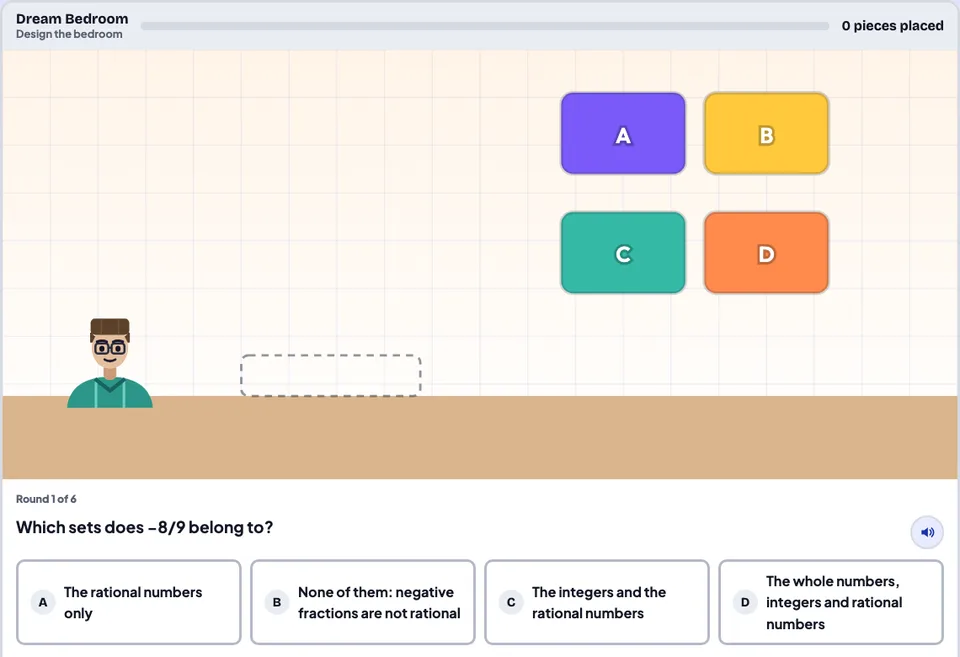
Dream Bedroom is a design game, and placing a piece means deciding which number sets −8/9 belongs to. The distractor that says negative fractions are not rational is a misconception the item bank catalogues, not a wrong answer made up to fill a slot.
The mathematics is the move
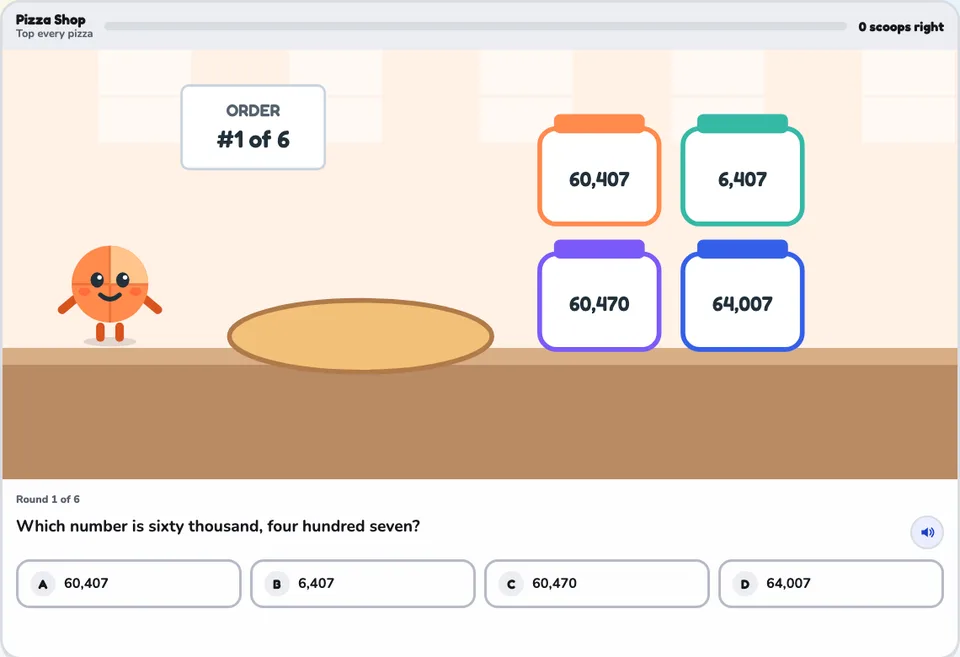
Pizza Shop is a game about filling orders, and filling one correctly means reading sixty thousand, four hundred seven and picking it out of three numbers built to look like it. The misconception is the gameplay.
One skill, more than one game
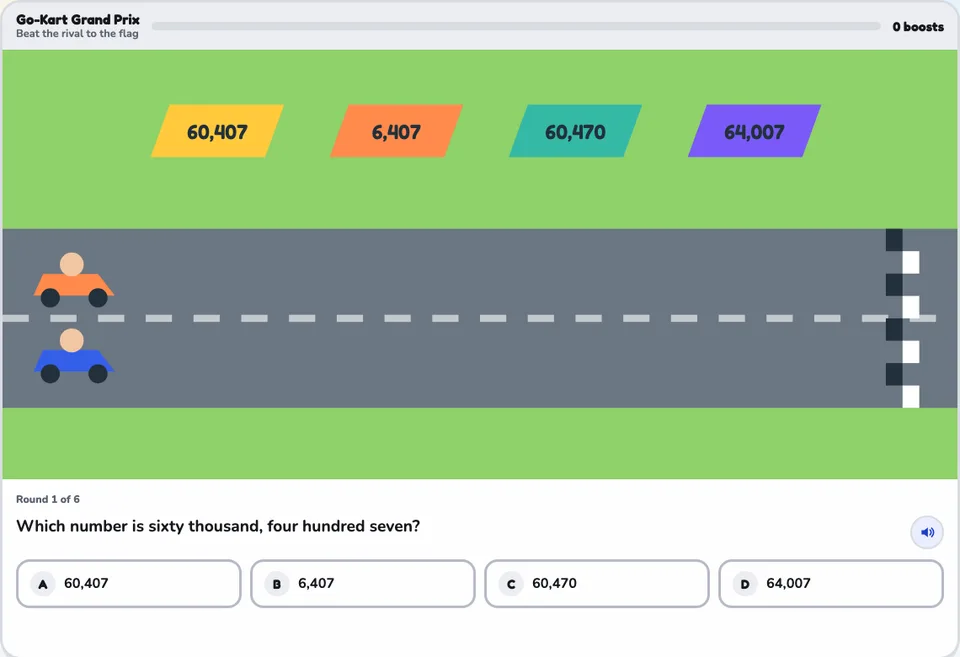
Go-Kart Grand Prix asks the same place-value question the Pizza Shop asked, and asks it in a different genre. A child who only ever met that skill in one game has learned the game, not the mathematics.
Grades 5 to 8 get their own skin
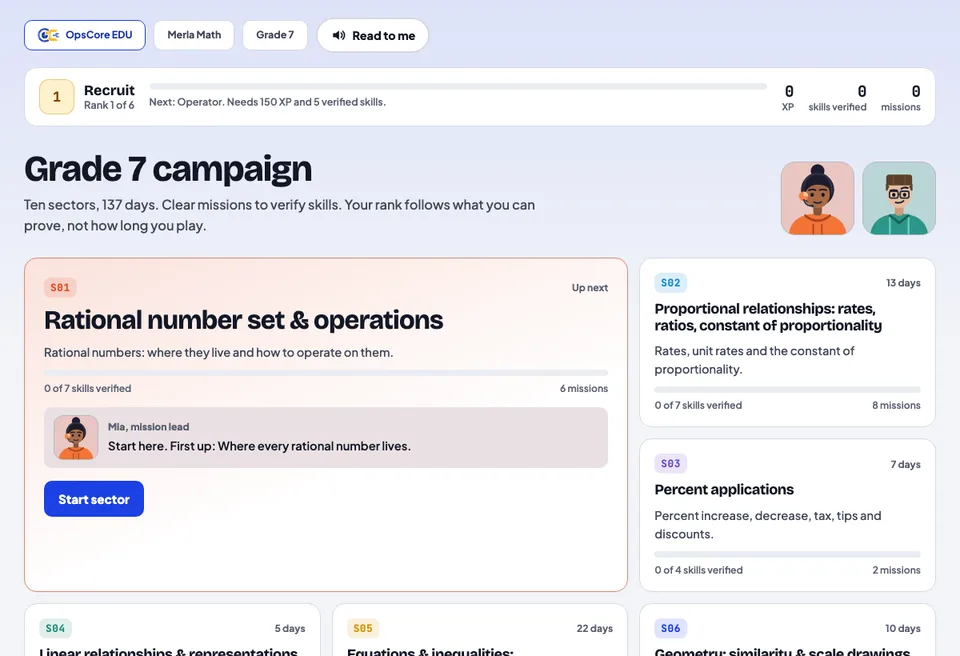
A Grade 3 adventure becomes a Grade 7 campaign of sectors and missions: same engine, same mastery model, a look that does not embarrass a thirteen-year-old. Three bands, 3-4, 5-6 and 7-8, set by the student and never by the grade of the content in front of them.
Three people have to be right about this.
The teacher
Opens it before school and sees who needs them today, with the reason beside each name. Thirty children, one period, and a list that is already sorted.
The campus and the district
Sees which grade is slipping and which campus is off pace against the STAAR calendar, while there are still weeks to do something about it.
The child
Gets a game they would choose to play, read aloud when they need it, and is never told they are behind in a number.
What the mathematics module does.
The commitments the build is held to, and the ones the other modules will inherit.
- Adaptive without demotion
- Instruction meets the student where they actually are, and the enrolled-grade requirement never comes off the table. Scaffolding back is targeted remediation that returns them to grade level, not reassignment to a lower one. A child is never shown a grade-level number for their learning level.
- A pacing rail, not a percentage
- Progress runs against a calendar built backward from the STAAR date, so a teacher reads "13 points behind with 38 days left" instead of "61% complete".
- The warm-up decides where they go
- The lesson opens on a game that works out what the student already knows, then routes them: skip ahead, learn it, or fix the earlier skill first.
- Worked examples that move
- Animated walk-throughs with checks for understanding partway through, rather than a static solved example or a video nobody pauses.
- Read-aloud on every screen
- Grades 3-4 may not read fluently. Directions and screens can be read to the class, on every screen, not only the ones that remembered to support it.
- Every adaptive decision is explainable
- A teacher can ask why a student was routed somewhere and get the misconception, the skill and the evidence behind it. 512 catalogued misconceptions sit under that answer.
- Rostering, not typing
- Classes arrive through district rostering rather than being keyed in by a teacher in August: OneRoster, Clever and ClassLink are the paths built against.
- Built for the room it runs in
- Chrome on Windows and macOS and iPad, mouse, keyboard and touch all first-class, touch targets sized for eight-year-olds, reduced motion honoured, and never red on a child for a wrong answer.
Play is the practice
Every lesson carries a real game, every unit has an arcade, and the mathematics is the move the game asks for. Children do not need to be bribed into a quiz.
Grade level is not negotiable
Adaptivity routes a student to the skill blocking them, then brings them back to the grade they are enrolled in. Nobody is quietly moved down a year.
Built to be read aloud
Read-aloud on every screen, touch targets sized for eight-year-olds, reduced motion honoured, and never red on a child for a wrong answer.
Not priced yet.
S.T.E.A.M. is not priced while the first module is still being built. Tell us your grades and how many campuses you are covering, and we will size it with you when it is. No placeholder number, no list price that moves later.
Straight answers.
What is actually built?
Mathematics. The curriculum data, the lesson and item schemas, the mastery model and the screens are done, and the module is in build. The screens on this page are captures of it. The other four letters are planned and marked coming soon wherever they appear.
What does S.T.E.A.M. mean here?
The platform a district buys. Each letter is a subject module on the same engine: one roster, one mastery model, one set of reports. Students see the module they are in rather than the platform name.
Which grades and which standards?
Grades 3 through 8, against the Texas TEKS. Mathematics launches with 313 standards and 549 skills mapped, with a K-8 prerequisite graph so remediation can reach below grade level without moving the student there.
What do students use it on?
Chrome on Windows and macOS, and iPad. Phone layouts are out of scope on purpose: this is classroom work, not a phone app.
Does it replace the teacher?
No, and it is not designed as though it could. It decides what a student should do next and tells the teacher why, so the adult in the room spends the period on the children who need them.
What does it cost?
Pricing is not set yet. Tell us your grades and campus count and we will work it out with you rather than putting a placeholder number on a page.
Bring us one grade level.
We will walk a unit end to end: the warm-up that routes a student, the game they play, and what their teacher sees on Monday morning.
Enquire about S.T.E.A.M.