Sixteen units, in the order a director needs them.
16 units, 81 lessons and 120 hours of instruction, then a 24-hour practicum: 144 clock hours in all, every one of them tied to the objective it evidences.
Orientation 2 h
Unit 0The Director's Legal Landscape2 h · 3 lessons
Child development 76 h
Unit 1Ages & Stages of Development10 h · 5 lessons
Unit 2Infant & Toddler Care: Safe Sleep, Feeding & Daily Care8 h · 5 lessons
Unit 3The Learning Environment & Curriculum10 h · 6 lessons
Unit 4Guidance & Discipline8 h · 5 lessons
Unit 5Health Practices10 h · 7 lessons
Unit 6Safety, Supervision & Ratios12 h · 8 lessons
Unit 7Emergency Preparedness & Fire Safety6 h · 4 lessons
Unit 8Observation, Documentation & Child Protection6 h · 4 lessons
Unit 9Families, Community & Program Philosophy6 h · 6 lessons
Business management 36 h
Unit 10The Management Cycle: Goals, Planning & Evaluation8 h · 5 lessons
Unit 11Fiscal Management: Budgeting, Pricing & Purchasing6 h · 3 lessons
Unit 12People: Hiring, Training, Supervision & Evaluation8 h · 6 lessons
Unit 13Leadership, Professionalism & Communication6 h · 5 lessons
Unit 14Operating the Center: Procedures, Records, Nutrition & Compliance8 h · 5 lessons
Capstone 6 h
Unit 15Capstone: Chapter 746 Compliance Audit6 h · 4 lessons
Practicum24 hours at a licensed Texas centre, every entry signed by the site supervisor.
Final exam67 questions. Passing means 80% overall, at least 70% in every domain, and all 15 critical items right.
The credentialIssued only when all three are met, the capstone audit is scored Meets or Exceeds, and the learner's identity is verified.
Taught from the rules · Chapter 746, quoted
Competing programs are recognized. This one is auditable.
Sixteen units, eighty-one lessons and 144 clock hours including a 24-hour practicum, every one of them tied to the objective it evidences. The difference is what is left behind after the learner finishes.
The rule is the content
Every lesson quotes the governing Chapter 746 rule and links to its exact page in the official PDF. The learner reads the policy before anyone explains it to them, which is also how they will have to work once they are running a centre.
Progress the learner cannot talk their way past
A lesson finishes when credited active time and the check both clear. A unit finishes when the quiz clears, every critical item is correct and the artifacts are in. The next unit unlocks after that, and the server decides, not the browser.
Objective by objective, provable
The whole design answers one question: can you show, record by record, that this learner met all 42 state learning objectives. Every grade traces to one.
Cite, do not paraphrase
A paraphrase of a rule is somebody’s opinion about a rule. Lessons quote the section and link the page, so a director learns to read the source they will be held to.
Gates the server enforces
Time credited on real activity, checks at eighty per cent, critical items that must be right. Nothing unlocks because a page was left open.
Written down while it happens
Scores, overrides and supervisor attestations are recorded as they occur and kept for at least three years, which is what makes a record survive a review.
Every grade explains itself · 42 state objectives
Every grade explains itself.
A score shows the learning objective behind it, the rubric level, who scored it and when. Where an instructor overrides what the system scored, the override carries a reason.
Objective 17 · Unit 4 of 16Met
A written discipline policy, scored against the rubric it was set from.
Reflects the prohibited practices in ruleSystem
Names who may authorise each methodSystem
!Gives staff a usable procedure, not a restatementInstructor · overridden, with reason
Written for the parents who must be given itSystem
Demonstration record. Invented learner, real course structure.
Knowledge scored by the system, performance by people
The platform scores what can be scored and puts performance artifacts in front of an instructor for confirmation or override. Judgement stays with a person; consistency stays with the system.
An override is never silent
Only an instructor may override a score. Every override needs a reason, and it cannot be changed once it is saved.
The practicum · 24 hours, signed
A practicum that is actually witnessed.
Practicum hours happen at a licensed Texas centre, are logged in the platform and are electronically signed by the site supervisor. Hours nobody can verify are worth nothing in a review, so they are not accepted on trust.
Six practicum hours signed by the site supervisor who watched them, and the rest credited on real active time.Demonstration record. Invented learner, real course structure.
Can our centre supervise it?
Yes, if the supervising person meets the director qualification rule. They verify the hours and attest to the artifacts they observed, and both are signed in the platform.
24 of the 144 hours
The practicum is part of the clock hours, not an extra, and it is recorded entry by entry like everything else.
Simulations · Scored against the rule
Practice the morning before you run one.
Simulations put the rule in a room and score the learner against the rule it comes from.
Unit 6 · built
Ratio Rush
Staff four rooms through the morning rush against the §746.1601 ratio chart, and see the moment a room goes over.
Unit 7 · coming next
Inspection Walk
Walk a classroom and find what a licensing inspector would find.
Records for a review · Kept at least 3 years
Records built for an unannounced review.
Anything a learner, instructor or supervisor does leaves a record. Records are retained for at least three years and feed the state renewal form, because Child Care Regulation may audit without notice.
Written down while it happens
Scores, overrides and supervisor attestations are recorded as they occur, not reconstructed afterwards.
Course material stays with the course
Selection, copy and print are disabled, each learner’s view is watermarked, and the page blurs when it loses focus. Stated openly as deterrence, and never at the expense of assistive technology.
Who it is for · Texas centre directors
Who this is for.
Adults already working in Texas child care, studying for the job they are about to be given.
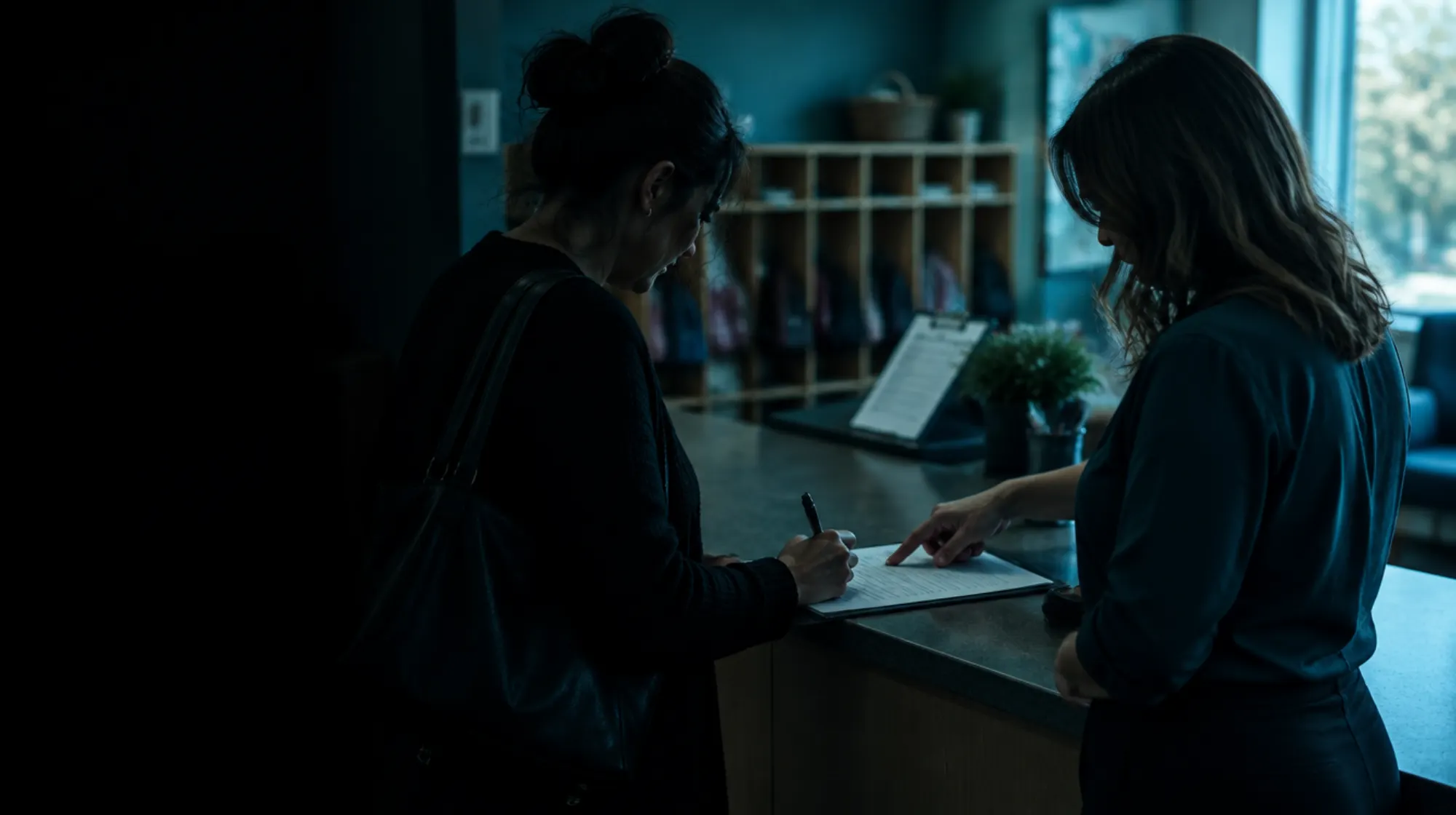
The job the credential is for. Everything in the course is aimed at this room.And the evening it is studied in, after the shift that paid for it. Photography shot for OpsCore CCR.
Built for adults studying after a shift
Phone-first and fully usable on a laptop, because the learner is a teacher or assistant director fitting study around a working day. Calm and clear, with no gamified noise.
English now, Spanish-ready by construction
Every string is externalized and every layout tolerates roughly thirty per cent longer text, so Spanish is a translation job rather than a rebuild. Rule quotations stay in the state’s official English.
The lessons are set in a centre you will recognise, with four people in it.
Your guideA veteran director who walks each rule through a real room.
The new directorLearning the job the way the learner is.
The lead teacherThe classroom the rules are about.
The inspectorThe licensing visit the records are for.
Where it stands · Not priced yet
Where the program stands.
OpsCore CCR is prepared for recognition by Texas HHSC Child Care Regulation under 26 TAC Chapter 745, Subchapter P. It is not recognized yet, and we will not describe it as recognized, approved or accredited until the Certificate of Recognition issues. Texas enrollment stays locked until that certificate and the workforce exemption letter are both recorded.
There are no learners yet, so there are no pass rates, testimonials or outcomes on this page. When there are, they will be real ones. A credential program that oversells itself is the last place you want to learn what a regulator does about it.
Pricing coming soon
Not priced yet.
Pricing is not set while recognition is pending. Tell us how many of your staff need the credential and we will size it with you when enrollment opens.
Adults working in Texas child care who need the Day Care Administrator’s Credential to be designated a centre director. Most are already teachers, lead caregivers or assistant directors.
Is the program recognized by the state?
Not yet, and we will not say otherwise until it is. It is prepared for recognition by Texas HHSC Child Care Regulation under 26 TAC Chapter 745, Subchapter P. Enrollment stays closed until the Certificate of Recognition and the workforce exemption letter are both in hand.
What does the credential let someone do?
It is one of the ways a person qualifies to be designated the director of a licensed child-care centre under the director qualification rules. What it does not do is promise anyone a job, and this program will never claim it does.
How long does it take?
144 clock hours in total, including the 24-hour practicum. How quickly that is covered depends on the learner, because the hours are credited on real active time rather than on the calendar.
Can our centre supervise the practicum?
Yes, if the supervising person meets the director qualification rule. They verify the hours and attest to the artifacts they observed, and both are signed in the platform.
What does it cost?
Not set yet. Tell us how many staff you are putting through it and we will work it out with you.
Ask for one unit.
We will walk you through a unit end to end: the rule it quotes, what the learner has to produce, and the record a reviewer would be shown afterwards.























 The new director
 The lead teacher
 The inspector